 MASSIV
FREE TOOL
Training Max Calculator
Your training max is the number a percentage-based program actually runs on. Set it here, and see every working weight for the full four-week wave — deload included.
Err low. A training max you can hit for a solid set of five on a bad day will carry you for months. One set too heavy stalls the whole wave.
| Week | Reps | Working sets |
|---|
MASSIV RUNS THE WAVE FOR YOU
Real programs, not templates.
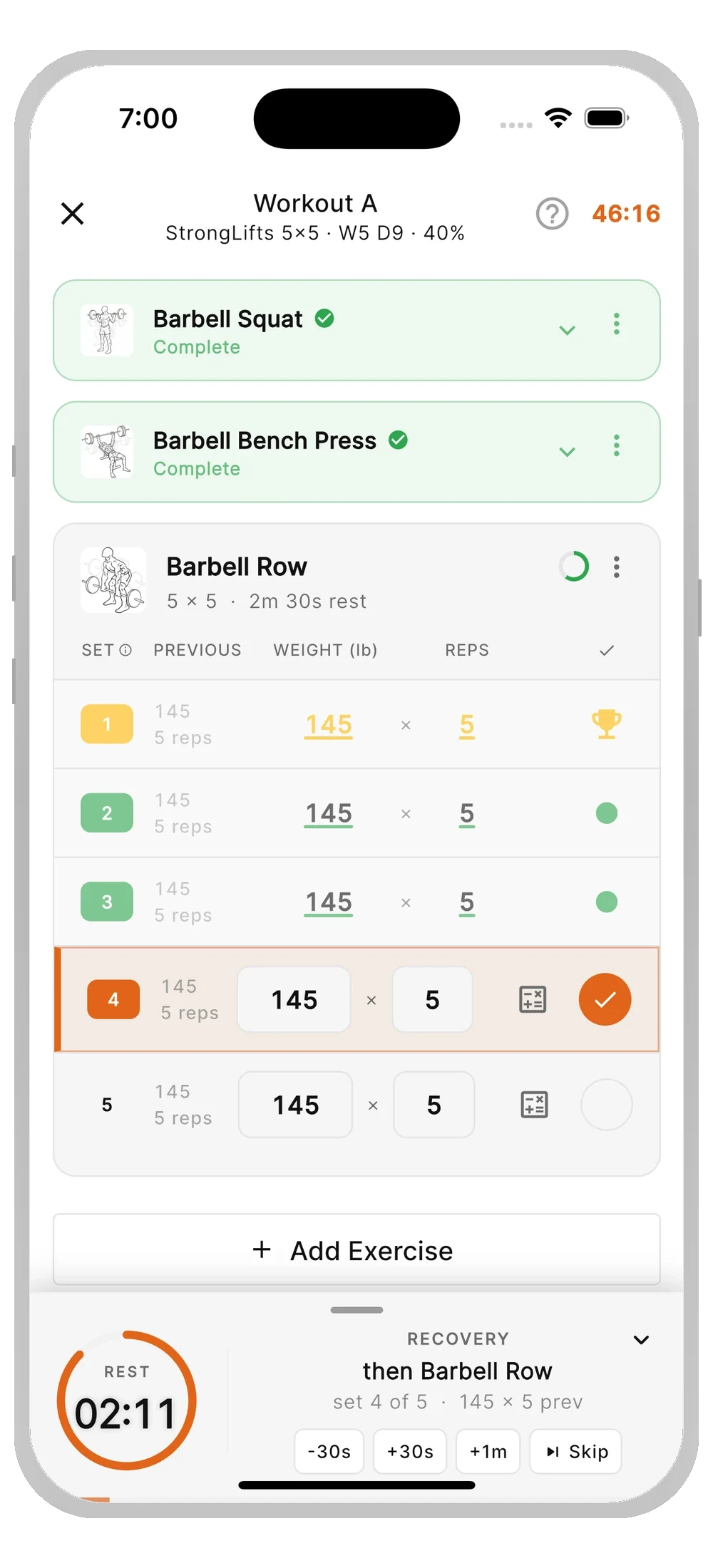
Massiv holds your training max per lift, calculates every session's weights, rounds them to the plates you actually own, and raises the TM when your AMRAP set earns it — showing you the rule that fired.


What is a training max?
A training max (TM) is a deliberately conservative number you program against instead of your true one rep max. If your best squat single is 315 lb, your training max might be 268 lb — and every percentage in your program is calculated from that lower figure.
This sounds like leaving progress on the table. It isn't. A true 1RM moves week to week with sleep, stress and fatigue, so programming directly off it means half your sessions are unintentionally maximal. A TM gives you a stable base: your prescribed weights stay achievable on bad days, which is what lets a wave run for months without stalling.
85% or 90%?
Both are defensible, and the calculator offers both:
- 90% — Jim Wendler's original 5/3/1 recommendation. Slightly more aggressive, and it assumes your 1RM figure is honest.
- 85% — what Massiv's progression engine uses. More margin, more reps on your AMRAP sets, and a longer run before you need to reset.
If you're unsure, or if your 1RM is an estimate rather than a tested single, take 85%. The cost of a TM that's slightly too light is a few easy weeks. The cost of one that's too heavy is a failed wave and a reset.
The 4-week wave
These are the percentages Massiv ships in its 5/3/1-style program. Every number is a percentage of your training max — never of your 1RM. At a 300 lb TM:
| Week | Reps | Percentages | Weights (300 lb TM) |
|---|---|---|---|
| Week 1 | 5 / 5 / 5 | 65% · 75% · 85% | 195 / 225 / 255 lb |
| Week 2 | 3 / 3 / 3 | 70% · 80% · 90% | 210 / 240 / 270 lb |
| Week 3 | 5 / 3 / 1 | 75% · 85% · 95% | 225 / 255 / 285 lb |
| Week 4 | Deload | 40% · 50% · 60% | 120 / 150 / 180 lb |
| Supplemental | 5 × 10 | 55% | 165 lb |
Week 3 is the heaviest and week 4 pulls right back — that's the point of a wave. The deload isn't optional padding; it's what makes the next cycle possible. Full detail on the structure is in our guide to 5/3/1.
When to raise your training max
After a completed wave, not after a good session. The standard increment is small on purpose: +5 lb (2.5 kg) for upper-body lifts and +10 lb (5 kg) for squats and deadlifts, per cycle.
The signal to raise it is your AMRAP set. If your final set at 95% still produces comfortable reps beyond the target, the TM is behind your actual strength. If you're grinding to hit the prescribed number, hold it where it is — or drop it 10% and rebuild. Massiv watches this automatically: it compares a rolling estimate of your strength against your stored TM and flags the gap rather than waiting for you to notice.