 MASSIV
StrongLifts 5×5 Program: Workouts and Progression

StrongLifts 5×5 is a beginner barbell program with five lifts and two alternating full-body workouts. Train three times per week with at least one rest day between sessions, complete 5×5 on most lifts (the deadlift is 1×5), and add weight the next time you complete every prescribed set. If you miss reps, repeat that lift; after three failed sessions at the same load, reduce it about 10% and build back up.
What is StrongLifts 5×5?
StrongLifts 5×5 is a beginner barbell program built on five compound lifts: the squat, bench press, deadlift, overhead press and barbell row. You train three days a week, alternating two workouts, doing 5 sets of 5 reps on most lifts — and you add weight every single session. It’s a linear progression: progress comes in a straight line, session over session, for as long as your body can keep recovering between workouts.
The two workouts
There are only two sessions, and you alternate them three times a week (e.g. Mon/Wed/Fri):
| Workout A | Workout B |
|---|---|
| Squat 5×5 | Squat 5×5 |
| Bench press 5×5 | Overhead press 5×5 |
| Barbell row 5×5 | Deadlift 1×5 |
You squat every workout. The program prescribes one heavy work set of five for the deadlift rather than 5×5 because it already includes frequent squatting. A week looks like A–B–A, then B–A–B the next week. If three sessions are not sustainable, the official guide also permits two per week; keep at least one rest day between workouts and continue alternating A and B.
Choosing your starting weights
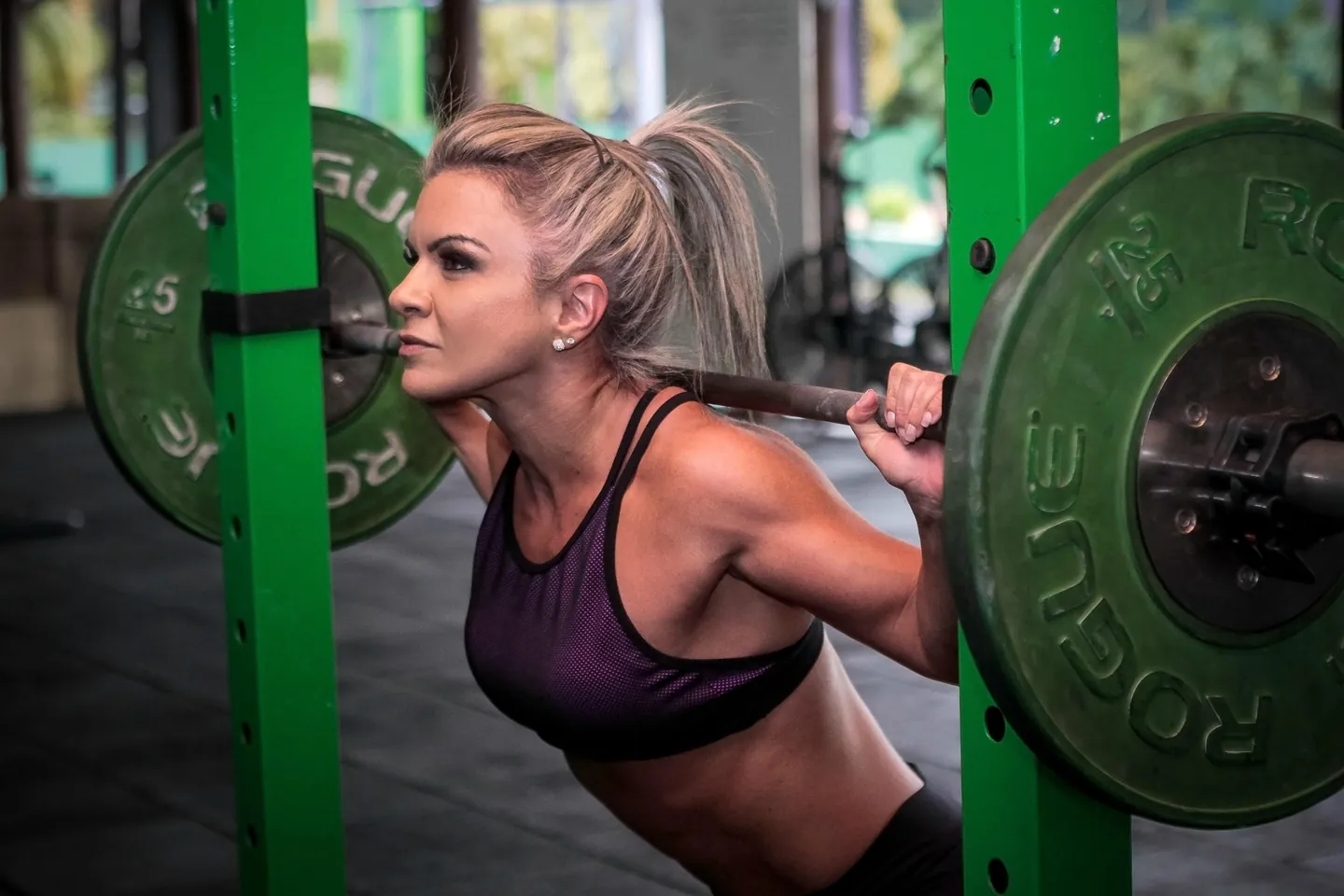
If you have never used the lifts, the official starting point is the empty 45 lb / 20 kg bar for squat, bench press and overhead press, with a light 65–95 lb / 30–40 kg starting load for rows and deadlifts. If you have trained before, use a conservative weight you could perform for about 10 good reps as your first 5×5 load. Starting easy gives you time to practice form before the progression becomes demanding.
The progression rule
This is the entire engine of the program:
- Add the standard 5 lb (2.5 kg) after completing every prescribed set for a lift.
- The beginner template can use 10 lb (5 kg) deadlift jumps early. Reduce the increment as the lift becomes harder.
- Progress each lift independently. A failed overhead press does not stop the squat or row from increasing.
Five pounds is a default, not a permanent requirement. Fractional plates and smaller or less frequent increases can extend productive progression, especially on bench press and overhead press.
Warming up
Your 5×5 sets are work sets, not warm-ups. Before the first work set of each lift, use lighter ramp-up sets from the empty bar toward the working weight. The number of steps depends on how heavy the work set is; keep the warm-up easy enough that it prepares the movement without tiring you.
The deload rule (what to do when you miss)
Eventually you’ll fail to get all 25 reps on a lift. The rule:
- If you miss reps, repeat the same weight next session rather than adding.
- If you fail the same weight three sessions in a row, deload by 10% on that lift and build back up.
- Apply the repeat or deload only to the lift that failed; the other lifts keep their own progression.
Before treating one bad session as a true stall, check rest time, sleep, food intake and technique. Smaller increments can also make progression smoother. The three-attempt rule exists because a single missed workout may simply be a bad day.
Why 5×5 stalls (and what to do)
Linear progression can’t last, by design. Adding 5 lb three times a week is a roughly 15 lb weekly squat increase — sustainable for a beginner whose body is adapting fast, impossible forever. At some point the jumps outpace your ability to recover between sessions, the five-rep sets start grinding, and you stall for good. Deloading just walks you back into the same wall a few weeks later.
That is not a fixed week on the calendar. Continue while you can complete new loads or return from a deload and exceed the previous best. If the same lifts repeatedly fail, deload and stall again despite smaller jumps and adequate recovery, use a program with slower progression: GZCLP keeps session-to-session loading but changes rep schemes after failures, while 5/3/1 uses a conservative training max and longer waves.
Common mistakes
- Starting too heavy. Robs you of the easy ramp that builds technique — and shortens the whole run.
- Adding too much assistance work. Assistance is optional. Add a small amount only if it supports your goal without reducing performance on the five main lifts.
- Skipping warm-up sets. Jumping directly to a heavy work set gives you no chance to rehearse the movement or notice a poor setup.
- Ignoring the deload rule. Grinding the same failed weight for weeks instead of deloading 10% just digs the hole deeper.
- Repeating unproductive cycles indefinitely. When smaller jumps and repeated deloads stop producing new bests, change the progression model rather than restarting the same cycle forever.
Common questions
How long should you run StrongLifts 5×5? There is no universal number of weeks. Run it while the session-to-session increases and occasional deloads still lead to new bests. Move on when repeated cycles no longer do so despite appropriate recovery and smaller increments.
Is StrongLifts 5×5 good for building muscle? It can build muscle and strength for beginners, but its fixed exercise selection and low deadlift volume are not designed to maximize every muscle group. Lifters whose main goal becomes hypertrophy often move to a program with more targeted weekly volume.
Why is the StrongLifts deadlift only 1×5? Workout B uses one heavy deadlift work set while the program already squats every session. Warm-up sets are separate and do not count as the 1×5 work prescription.
How Massiv handles this for you
StrongLifts is simple to understand and tedious to administer: the +5/+10 bumps every session, the A/B alternation, the warm-up ramp, the three-strikes deload rule. Massiv ships StrongLifts 5×5 as a built-in program and runs all of it — it tracks each lift’s weight, shows today’s working sets with the plates to load, calculates your warm-up ramp, and applies the deload automatically when you stall. And when 5×5 finally runs its course, you switch to GZCLP or 5/3/1 inside the same app instead of starting over — with your history intact.
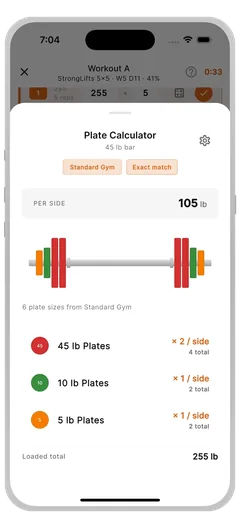
Massiv runs StrongLifts 5×5 for you — and has your next program ready when it stalls. Download Massiv and put it to work in the gym.
Download Massiv →StrongLifts 5×5 works because it’s brutally simple: five lifts, add weight, repeat. Start light, warm up properly, respect the deload rule, and ride the linear gains as far as they go. When they end — and they will — that’s your cue to move to a program built for what comes next.