 MASSIV
PHUL vs PPL: Which Should You Run?
Choose PHUL if you can train four fixed days and want heavy strength work built into a size-focused week. Choose PPL if you want a movement-based split that can fit three days or expand to six. Neither label guarantees better results: the useful difference is how each structure fits your schedule, weekly work, and recovery. This guide compares those tradeoffs and shows how to choose without treating one split as universally better.
What PHUL is
PHUL — Power Hypertrophy Upper Lower — is a four-day split that splits the week by both body region and training style:
- Day 1 — Power Upper: heavy upper-body compounds, low reps (3–5).
- Day 2 — Power Lower: heavy squat/deadlift work, low reps.
- Day 3 — Hypertrophy Upper: upper-body work, higher reps (8–15), more isolation.
- Day 4 — Hypertrophy Lower: higher-rep leg and posterior-chain work.
The idea is that the two "power" days emphasize heavier work while the two "hypertrophy" days use more moderate rep ranges, and each muscle group is trained twice a week. The widely circulated PHUL template credited to Brandon Campbell is a four-day, intermediate program. For the full day-by-day layout and progression notes, see our dedicated PHUL guide.
What PPL is
PPL — Push Pull Legs — splits the week by movement pattern instead of training style:
- Push: chest, shoulders, triceps.
- Pull: back, rear delts, biceps.
- Legs: quads, hamstrings, glutes, calves.
Its defining feature is flexibility of frequency. Run it three days a week and each muscle is trained once; run it six days a week (push/pull/legs twice) and each pattern is repeated twice. The split itself does not determine strength or hypertrophy results—the exercises, loads, weekly sets, effort, and progression do. See our PPL guide for a complete setup.
PHUL vs PPL: the head-to-head
| PHUL | PPL | |
|---|---|---|
| Days per week | 4 (fixed) | 3 or 6 (flexible) |
| Split logic | By style (power vs hypertrophy) + region | By movement pattern |
| Frequency per muscle | 2× / week | 1× (3-day) or 2× (6-day) |
| Built-in emphasis | Heavy work + moderate-rep work | Movement pattern; goal depends on programming |
| Heavy low-rep work | Built in (power days) | Only if you program it |
| Schedule fit | Best at exactly 4 days | Scales to your available days |
| Session length | Moderate | Shorter per session (work is spread out) |
Which should you run?
Pick based on three things, in this order:
1. How many days can you reliably train? This decides it more than anything. Four days, consistently → PHUL is purpose-built for that. Three days → PPL (or an upper/lower). Five or six days and you love the gym → 6-day PPL gives you the most weekly volume. Don't pick a 6-day program for a 4-day life; the best split is the one you actually complete.
2. Do you want heavy work prescribed by the split? PHUL makes heavier compound work explicit on two days. PPL leaves the loading and rep ranges to the program you put inside the split, which gives you more freedom but also more decisions. If pure strength is the priority, a strength system such as 5/3/1 may be a clearer fit.
3. Do you like heavy, low-rep work? PHUL forces it on you twice a week. Some lifters love that; others find sub-5-rep training joyless and recover better living in the 8–15 range, which PPL lets you do.
A few common questions
Is PHUL better for beginners than PPL? Neither is really a beginner program — both assume you can already perform the main lifts and need more volume than a linear progression. A true beginner is better off on GZCLP or 5×5 first.
Can I switch between them? Yes, and many lifters do — running a powerbuilding block on PHUL, then a higher-volume hypertrophy block on 6-day PPL. Just don't program-hop every two weeks; give each split 8–12 weeks to actually produce a result.
Which builds more muscle? Research does not support declaring a winner from frequency alone when weekly volume is matched. A 2019 systematic review and meta-analysis found no meaningful hypertrophy advantage from higher frequency under volume-equated conditions. Choose the structure that lets you complete and progress an appropriate amount of weekly work.

A sample PHUL week
To make the split concrete, here's the shape of a PHUL week. Power days lead with a heavy compound; hypertrophy days raise the reps and add isolation:
| Day | Lead lift | Rep feel |
|---|---|---|
| Power Upper | Bench / row, heavy | 3–5 reps on mains, 6–8 on the rest |
| Power Lower | Squat / deadlift, heavy | 3–5 reps, low volume, high intent |
| Hypertrophy Upper | Incline / machine press, dumbbell work | 8–15 reps, more isolation |
| Hypertrophy Lower | Front squat / leg press, accessories | 8–15 reps, quad/ham/glute detail |
You train Monday/Tuesday, rest Wednesday, train Thursday/Friday, then rest the weekend — a clean four-day rhythm.
A sample PPL week (3-day and 6-day)
PPL's flexibility is the whole point. The 3-day version is Push / Pull / Legs across the week—each pattern once, with more days between sessions. The 6-day version runs the same three patterns twice. Six days creates more opportunities to distribute weekly sets, but it does not require more total volume:
| Session | Trains | Typical work |
|---|---|---|
| Push | Chest, shoulders, triceps | Bench, overhead press, dips, lateral raises, pressdowns |
| Pull | Back, rear delts, biceps | Rows, pull-ups/pulldowns, face pulls, curls |
| Legs | Quads, hams, glutes, calves | Squat, RDL, leg press, lunges, calf work |
If you want a deeper leg session inside a PPL, our glute hypertrophy guide shows how to bias the lower body without breaking the split.
How you progress on each
Neither split progresses itself — that part is on you. On PHUL's power days, progress like a strength program: add a small amount of weight to the main lifts when you hit your target reps, much like the linear or wave loading in 5/3/1. On PHUL's hypertrophy days and on all of PPL, use double progression: stay at a weight until you reach the top of the rep range on every set, then add load and rebuild the reps. The split is the container; progressive overload is what's actually inside it.
Recovery and volume
A practical difference: six-day PPL spreads training across more gym visits, while PHUL concentrates the week into four sessions. Recovery depends on the actual sets, loads, effort, sleep, nutrition, and stress—not the split name. If six reliable gym days are unrealistic, choose four-day PHUL or a three-day PPL rather than planning sessions you will regularly miss.
How Massiv handles this for you
Whichever you choose, the work that decides your results is the same: progressing each lift session to session and not losing track of your volume. Massiv ships both PHUL and multiple PPL variants (3-day and 6-day) as built-in programs, loads today's session for you, carries your weights forward, and advances each lift on its own progression rules — so the split is just a structure, not a spreadsheet you have to maintain.
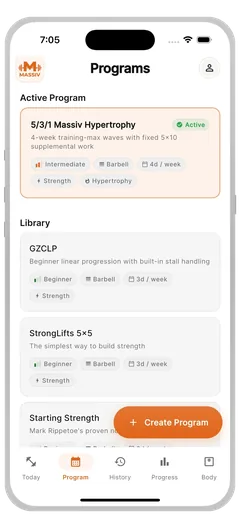
Massiv runs the progression math for this program automatically. Download Massiv and put it to work in the gym.
Download Massiv →PHUL and PPL aren't rivals so much as answers to different questions. Train exactly four days and want strength plus size? PHUL. Want flexible frequency and a hypertrophy focus that scales with your schedule? PPL. Match the split to your week and your goal, then give it a few honest months.